
REVIEW · HISTORICAL TOURS
Biblical Corinth Taste Faith & History with wine & Oil Tasting
Corinth packs centuries into one short outing. This private trip from Athens links the Corinth Canal, ancient trade routes, Saint Paul’s connection to the area, Roman ruins, and the fortress of Acrocorinth. I like the small-group format, with only your party in a sedan or minivan, and I like the freedom to adjust stops, lunch, and even the drop-off point. The main caution is time: five hours is tight for Ancient Corinth, its museum, Isthmia, lunch, and Acrocorinth, especially if you want a proper archaeological visit.
The driver adds real value when explaining the sites, as Panos, Periklis, Nikos, Andreas, and Christos have done for different parties. Still, this is not automatically a licensed guided tour. A licensed guide costs an additional €140 per person, while the wine and oil tastings also cost extra, so the final price can rise well above the advertised $190.46 per person.
Key points before you book
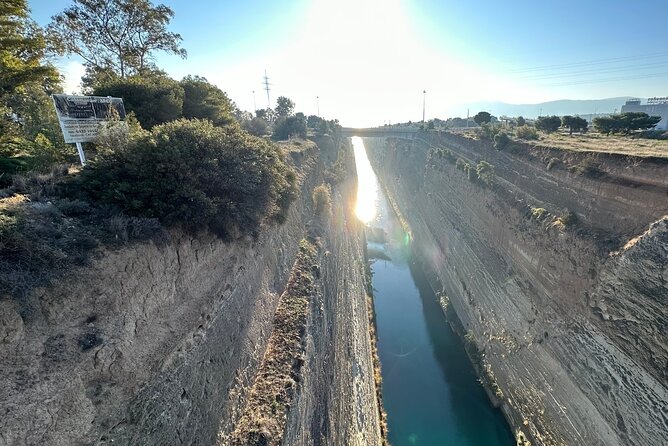
- The Corinth Canal is a quick but striking opening stop, showing the narrow divide between mainland Greece and the Peloponnese.
- Ancient Corinth connects Greek, Roman, and Christian history, including the city’s place in the journeys of Saint Paul.
- Acrocorinth delivers the biggest view, with a fortress high above the ancient city and the isthmus.
- This is a private vehicle tour, not a bus trip, with sedans for one to three people and minivans for four to seven.
- Wine tasting and oil-tasting finger food are optional extras, not part of the base fare.
- The archaeological sites and museums charge separately, so check the day’s opening arrangements before departure.
Why Corinth makes a strong half-day trip from Athens
Corinth sits on the narrow isthmus joining mainland Greece to the Peloponnese. That position made it a natural crossing point, trading center, military gate, and religious meeting place. It also explains why the area offers such a wide mix of sights in a small radius.
Ancient Corinth was one of Greece’s largest cities, with a population said to have reached 90,000 around 400 BC. Rome destroyed the city in 146 BC, then founded a new Roman Corinth in 44 BC. Later, the Romans made it the provincial capital of Greece.
For Christian travelers, Corinth carries another layer of meaning. Saint Paul spent time in the area, and the New Testament letters of First and Second Corinthians are linked to the early Christian community here. The tour’s religious focus is useful because it places the ruins in a living historical story, rather than treating them as disconnected stones.
The trip lasts about five hours. That makes it a practical choice if you have one free morning or afternoon in Athens, but it is not enough time for a slow, full study of every site. I would treat it as an introduction to Corinth, with the option to return for a longer visit if the ruins capture your interest.
More History Tours in Athens:
- Douro Valley: Historical Sites, Wine Experience, Lunch & Cruise
★ 5.0 · 5,133 reviews - Barcelona: Tapas Walking Tour with Food, Wine, and History
★ 4.8 · 4,261 reviews - Sevilla Food Tour: Tapas, Wine, History & Traditions
★ 5.0 · 3,468 reviews
The Corinth Canal: a 15-minute lesson in Greek geography

The first stop is the Corinth Canal, cut through the isthmus to link the Gulf of Corinth with the Saronic Gulf. The waterway separates the Greek mainland from the Peloponnese, turning the peninsula into an island in geographic terms.
You get about 15 minutes here, with no admission fee. That is enough for photographs and a quick explanation, but not a long visit. The canal itself is the point. From the viewing area, you can see how close the two bodies of water are and why engineers, rulers, and merchants dreamed of connecting them.
The canal opened in the late 19th century, but the idea reaches back about 2,000 years. Periander, the tyrant of Corinth, is credited with considering a canal around 602 BC. The ancient Greeks lacked the tools to cut through the rock, so they built the Diolkos instead.
The canal stop works best as a geographical introduction. You immediately understand why Corinth grew powerful, and why control of this strip of land mattered so much.
The Diolkos: an ancient ship railway
The Diolkos was a paved trackway that allowed boats and cargo to move overland across the isthmus. It avoided the long and dangerous journey around the Peloponnese, a detour of about 185 nautical miles for ships traveling between the Aegean and Adriatic routes.
The track stretched roughly 6 to 8.5 kilometers and operated from about 600 BC until the middle of the first century AD. Boats were placed on wheeled platforms and hauled across the land. It was an early form of railway, built for ships instead of trains.
You spend about 20 minutes here, again without a separate admission fee. The remains may not produce the instant drama of a temple or fortress, but the idea is remarkable. Corinth’s commercial success depended not only on its position, but also on practical engineering.
I would listen closely to the driver at this stop. Without explanation, a paved ancient route can be easy to miss. With context, it becomes one of the most memorable parts of the day.
Isthmia and Saint Paul’s Corinth
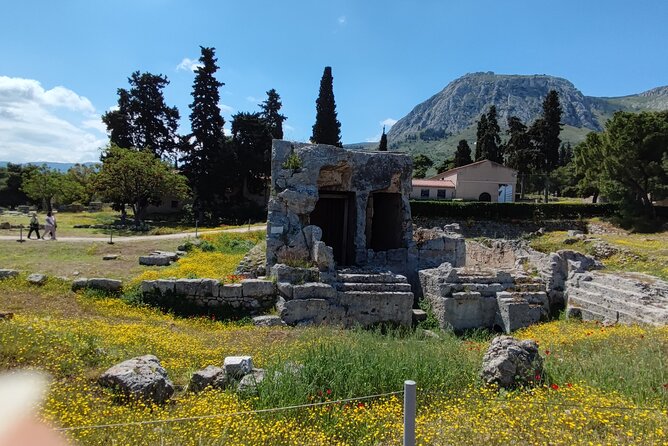
Near the canal lies Isthmia, the site of the Isthmian Games. These contests were among the most important athletic festivals in the ancient Greek world, second only to the Olympic Games in status.
You have about 30 minutes here. The site’s location matters as much as the ruins. Athletes, merchants, religious visitors, and sailors all passed through this narrow point between the Peloponnese and central Greece.
The Christian connection adds another reason to stop. Saint Paul is associated with the Isthmian region, and the tour explains his work as a tent maker serving the people connected with the games. He also preached Christianity in a setting filled with athletes and visitors from across the Greek world.
This is a good stop if you want the faith element of the outing to feel connected to a real place. The drawback is that 30 minutes gives you only a taste. You will not have time for a slow reading of every archaeological feature.
A few more wine tours around Athens worth a look
- Athens: Classic Cooking Class with Market Visit and Wine
★ 5.0 · 1,101 reviews - Athens: Food Market Visit and Cooking Class with Wine
★ 4.9 · 1,087 reviews - Athens: Swimming Cruise with Lunch, Wine & Live DJ on Board
★ 4.6 · 1,085 reviews - Best rated Acropolis Wine Tasting
★ 5.0 · 568 reviews
The Archaeological Museum of Isthmia
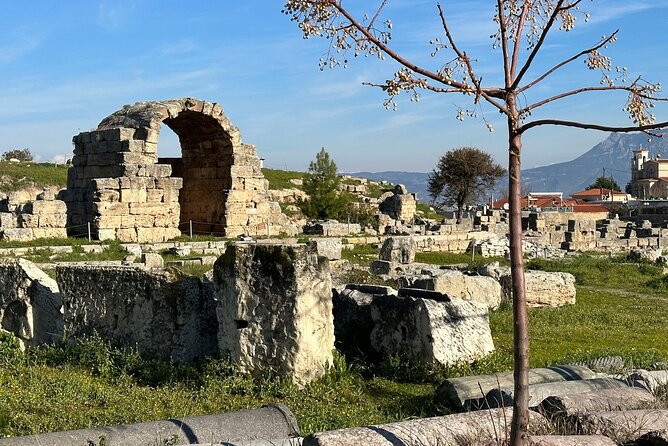
The Museum of Isthmia takes about 20 minutes, with admission not included in the base price. Its collection helps explain the religious, sporting, commercial, and domestic life of the area.
Notable pieces include an Archaic marble pediment from the Temple of Poseidon, dated to the end of the seventh century BC. The collection also includes colored glass panels from Kechreon, shipped from Alexandria in Egypt. Their scenes include harbors, plants, animals, ships, geometric designs, and full-length figures of philosophers such as Homer and Plato.
Other objects include an imperial statue in the type of Zeus, an athletic victory stele, animal figurines, commercial amphorae, weapons, cult offerings, and material from Mycenaean and Roman cemeteries. A small golden bull, offered to the sanctuary in the sixth century BC, is one of the more appealing details to watch for.
Twenty minutes is brief, so I would not expect a museum visit in the usual sense. It is more of a focused stop that gives shape to what you see outdoors.
Ancient Corinth: the main archaeological stop
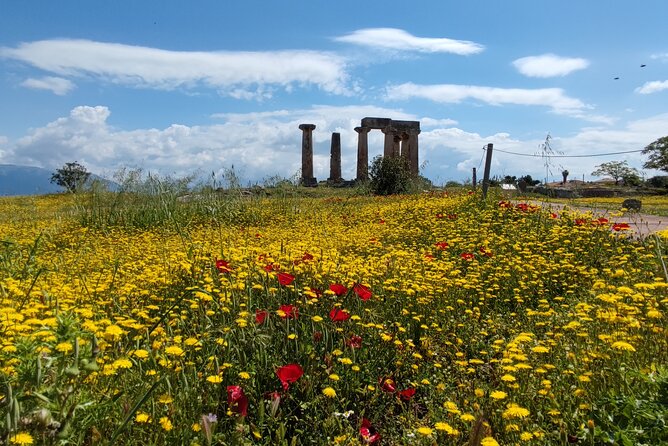
Ancient Corinth is the center of the trip. You have about one hour at the site, followed by another 30 minutes in the Archaeological Museum of Corinth and 15 minutes at the Temple of Apollo.
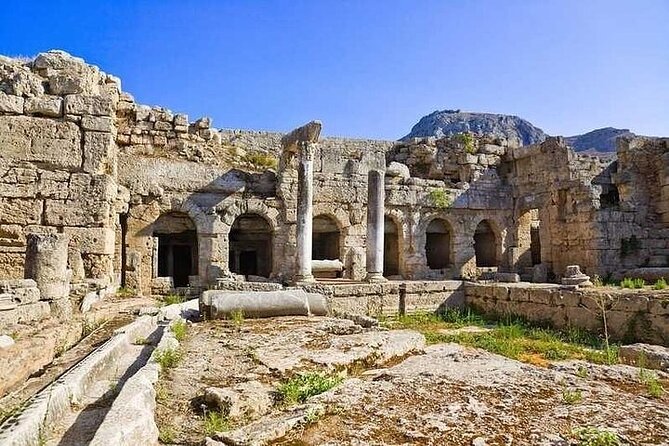
The ruins cover several periods. Greek Corinth was a major commercial city. Roman Corinth replaced the destroyed Greek city, and the later settlement became an administrative center. This mixture gives the site its appeal, but it can also make the remains harder to read without help.
The driver can point out major features such as the Lechaion Road, the agora, the Basilica, the Fountain of Peirene, the Stoa, the Odeon, and the Hadgimoustafa Spring. Several people have praised drivers such as Panos, Periklis, Nikos, Andreas, and Christos for making the ruins easier to understand and for adding historical detail along the way.
One practical issue matters here: the driver is not automatically a licensed archaeological guide. If you want formal site interpretation, you can request a licensed guide for an extra €140 per person. That is a steep addition, but it may suit visitors who want detailed classical history rather than a broad overview.
The site is also the part most vulnerable to schedule changes. One party arrived to find Ancient Corinth closed on a Tuesday because of film production connected with Christopher Nolan’s The Odyssey. The operator explained that the closure schedule had not been clear. Even if such a closure is unusual, I would confirm opening arrangements before committing to a nonrefundable last-minute booking.
The Archaeological Museum of Corinth and Temple of Apollo
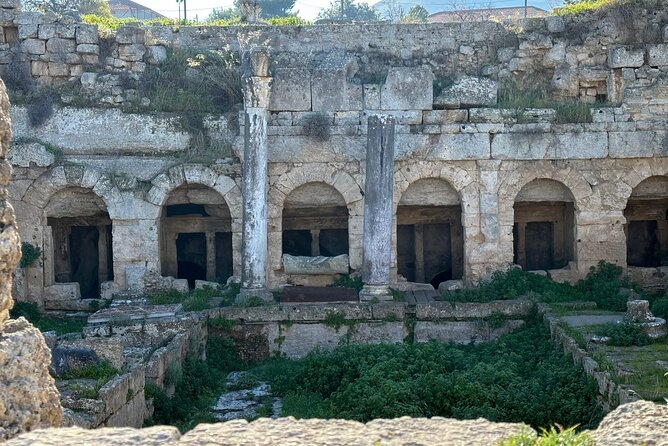
The museum sits inside the archaeological site and was built in 1931 and 1932 to display finds from the excavations. You have about 30 minutes, so use the driver’s explanations to decide what deserves your attention.
The surrounding ruins include the agora, the Lechaion Road, the Basilica, the Fountain of Peirene, the Stoa, and the Odeon. These places help you picture Corinth as a functioning city, not just a collection of isolated monuments.
The Temple of Apollo receives a separate 15-minute stop. Built around 550 BC, it is one of the early Doric temples in the Peloponnese and mainland Greece. Its large monolithic columns are especially notable because single-stone columns were unusual in the ancient world.
The schedule here is efficient but compressed. If Ancient Corinth is your main reason for booking, I would ask in advance how much time can be protected for the ruins and museum. The trip is flexible, but flexibility depends on the driver’s schedule and the number of stops you choose to keep.
Lunch, shopping, and the cost of tasting
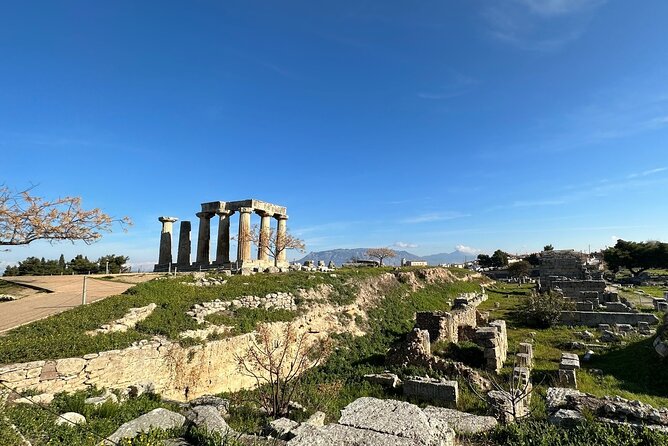
You receive about 45 minutes for lunch and shopping in Ancient Corinth. The meal is not included, and the driver may recommend a restaurant, as happened during one particularly well-regarded outing.
The tasting element needs careful attention before booking. Wine tasting costs €15 per person. Oil-tasting finger food is listed at €80 per person. Neither is part of the advertised base fare, so ask exactly what the €80 charge covers before adding it.
This is where the title can create confusion. The experience combines Corinthian history with the possibility of wine and olive oil, but those tastings are optional paid additions. If you want the archaeology and the views, you can keep the cost closer to the advertised rate. If you add entrance fees, tastings, a licensed guide, and lunch, the total becomes much higher.
The base price includes fuel, tolls, bottled water, air conditioning, WiFi, and private transportation. That is good value for a small private group, especially when split among several people. It is less compelling for a solo visitor once the extra fees are added.
Acrocorinth: the strongest view of the day
Acrocorinth is the ancient acropolis, a massive rock rising above Corinth. Its height and secure water supply made it a natural defensive position. The fortress repeatedly served as a last line of defense in southern Greece because it controlled access through the isthmus.
You have about 30 minutes here. That is enough to see the fortress and take in the view, but it is not a full exploration of the entire complex. Wear practical shoes and be ready for uneven ground, since the site is a fortified hill rather than a flat museum floor.
This was the part that made one party wish they had booked the full-day version. Another visitor reshaped the schedule around a Zulu bungy jump and still managed to see Acrocorinth afterward, which shows how much room there can be for personal adjustments when the group is private.
I would give Acrocorinth priority if your time is limited. The ruins at Ancient Corinth explain the city’s daily life, while Acrocorinth shows the larger military logic of the entire region. The view also gives you a clear sense of why this site mattered.
Private transport and the human side of the tour
Pickup and drop-off are offered from an Athens hotel, Airbnb residence, or port. The driver waits in the hotel lobby, at the apartment entrance, or at the port gate with a name sign. Airport pickup is available for an extra €60 per person, with flight monitoring included.
Groups of one to three use a luxury sedan. Groups of four to seven use a comfortable minivan. Only your party participates, which gives you more control than a standard coach outing.
The most praised feature is the driver service. Nikos was described as entertaining and attentive. Panos was credited with adding useful historical detail when information at the site was limited. Periklis gave a strong explanation of the Marathon battle, and Andreas helped a participant arrange time for a bungy jump. These details show why driver quality matters so much here.
You should still understand the distinction between a good driver and a licensed guide. The driver can explain, suggest, and adjust the day, but formal archaeological interpretation is an optional upgrade.
Who should book this Corinth tour?
I would recommend it to couples, families, and small groups who want Corinth without renting a car. It suits you especially well if you value door-to-door transport, flexible stops, and a driver who can connect the sites into one story.
It is also a good fit for visitors interested in Saint Paul, ancient trade, Greek temples, Roman administration, and fortress views. The mix is broad enough to keep a mixed-interest group happy.
I would hesitate if you want a slow archaeological study. Five hours leaves little spare time, and the admission fees and optional extras can push the total cost sharply upward. I would also confirm that Ancient Corinth and its museum are open on your chosen date, particularly if your schedule allows no room for disappointment.
Free cancellation is available up to 24 hours before the start time. Changes made inside that window are not accepted, and poor weather may lead to a new date or a full refund.
Final decision: a smart private introduction to Corinth
Book this tour if you want a well-organized private ride from Athens, a strong look at Acrocorinth, and a clear introduction to the canal, Diolkos, Isthmia, Ancient Corinth, and Saint Paul’s connection to the region. The drivers appear to be the heart of the experience, and the best ones turn a short schedule into an engaging history lesson.
Before paying, ask three questions: Is Ancient Corinth open on your date? Which entrance fees and tastings do you want to add? Do you need a licensed guide, or will the driver’s commentary be enough?
For a first visit, I think the tour offers a practical way to reach a difficult-to-organize area. Just budget honestly, protect enough time for Ancient Corinth, and treat the wine and oil tasting as optional extras rather than included features.
FAQ
How long does the Corinth tour last?
The tour lasts approximately five hours and returns to the meeting point or another agreed drop-off location.
Is pickup from Athens included?
Pickup and drop-off are offered from Athens hotels, Airbnb residences, and ports. Airport pickup is available for an additional €60 per person.
Is this a group bus tour?
No. It is a private tour for your party only. Groups of one to three use a sedan, while groups of four to seven use a minivan.
Are entrance fees included?
No. Entrance fees are not included. The listed cost for the archaeological site of Ancient Corinth is €15 per person, and admission to the attractions is handled separately.
Are wine and olive oil tastings included?
No. Wine tasting costs €15 per person. Oil-tasting finger food is listed at €80 per person.
Can I book a licensed guide?
Yes. A licensed guide can be requested, subject to availability, for an additional €140 per person.
Newly added around Athens
- Athens: Wine Workshop Create your Own Wine under the Acropolis★ 5.0 · 77 reviews
- Wine Trails Private Tour/ Nemea visit 3 wineries from Athens or Nafplion (10 h)★ 5.0 · 44 reviews
- Athens: Greek Wines Tasting with Sommelier and Acropolis Views★ 5.0 · 88 reviews
- Mercedes Private Tour Nafplio, Corinth Canal, Nemea Wine Tasting★ 5.0 · 142 reviews
- Acropolis Private Wine Tasting @ Finewine store★ 5.0 · 46 reviews
- Small-Group Wine Tour in Athens with Tasting★ 5.0 · 33 reviews
- Sail the Athenian Coastline on a Catamaran with Meal & Wine★ 5.0 · 165 reviews
- Private Athens By Night Food Tour & Wine Tasting of 5 Varieties★ 5.0 · 90 reviews
Historical Tours, compared.

Douro Valley: Historical Sites, Wine Experience, Lunch & Cruise
Read our review →
Tapas Walking Tour with Food, Wine, and History
Read our review →
Sevilla Food Tour: Tapas, Wine, History & Traditions
Read our review →
Valencia Old Town Tour with Wine & Tapas in 11th Century Historic Monument
Read our review →
Barcelona Tapas Walking Tour: Food, Wine & History
Read our review →
Ultimate Seville Tapas, Wine & History Small Group Tour
Read our review →
Daytime or Sunset Boat Cruise with History and Wine
Read our review →
Undiscovered Charleston: Half Day Food, Wine & History Tour with Cooking Class
Read our review →Browse the lists this tour appears in