
REVIEW · WINE TASTINGS
Trier: Guided City Walk with Wine Tasting
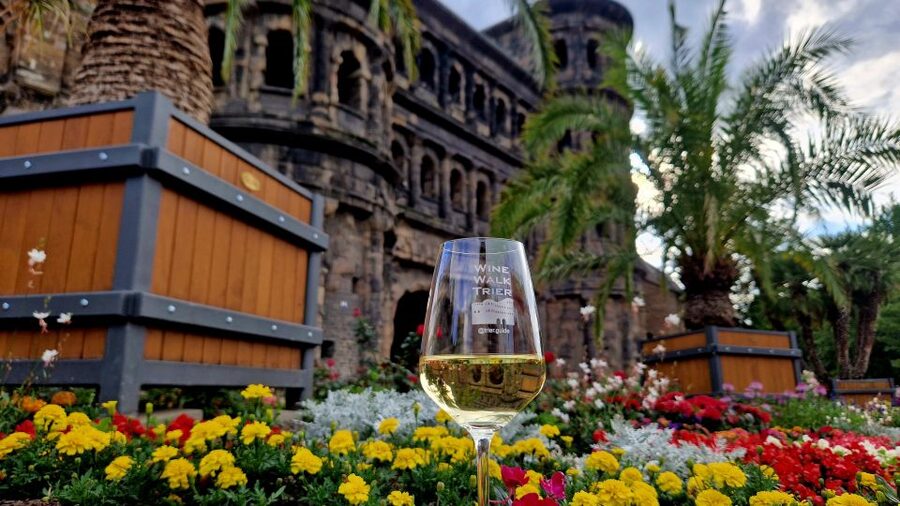
History tastes better with a local pour. This two-hour walk links Trier’s Roman monuments, churches, squares, and wine culture in one easy outing. I like the smart route from the Porta Nigra to the Forum Baths, and I like that each tasting has a connection to a place or story in the city. The main consideration is that you are drinking while walking, so this is more of a moving introduction than a slow, formal wine seminar.
The guide, Simon, receives especially warm praise for his humor, local knowledge, and patience with questions. I also like the practical extras: water, breadsticks, and a voucher for a glass of wine with a main course at Weinwirtschaft Friedrich-Wilhelm. If the weather turns wet, you still go, since the tour runs rain or shine.
Key points to know before booking
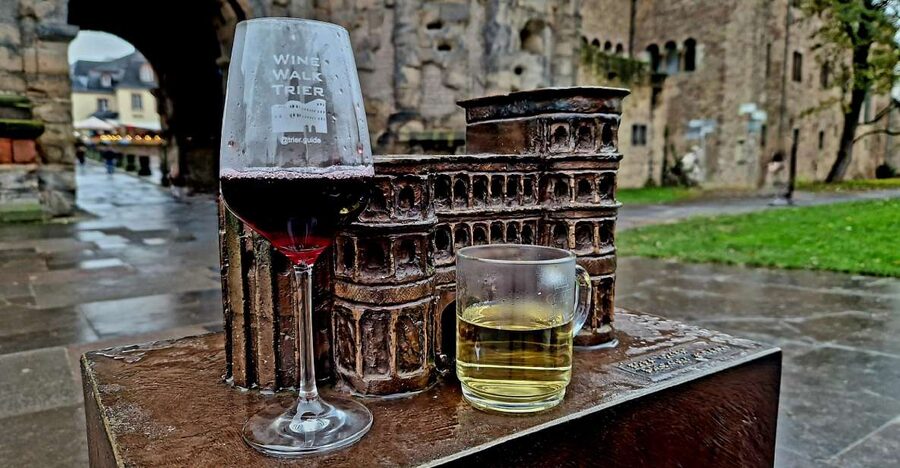
- Five regional wines in warmer months: Tastings are tied to Trier’s buildings, neighborhoods, and wine-making past.
- Four mulled wines in winter: From mid-November through January, the tasting changes to local Glühwein when at least six people register.
- A strong Roman and medieval route: You walk from the Porta Nigra through the market, cathedral area, palace grounds, Imperial Baths, and Forum Baths.
- Simon is a major part of the appeal: His personal connection to Trier and lively storytelling are repeatedly praised.
- Barrier-free and step-free: The route does not require climbing stairs and is wheelchair accessible.
- Good value at $43: You receive a two-hour guided walk, several drinks, water, breadsticks, and a restaurant wine voucher.
Why this Trier walk works so well
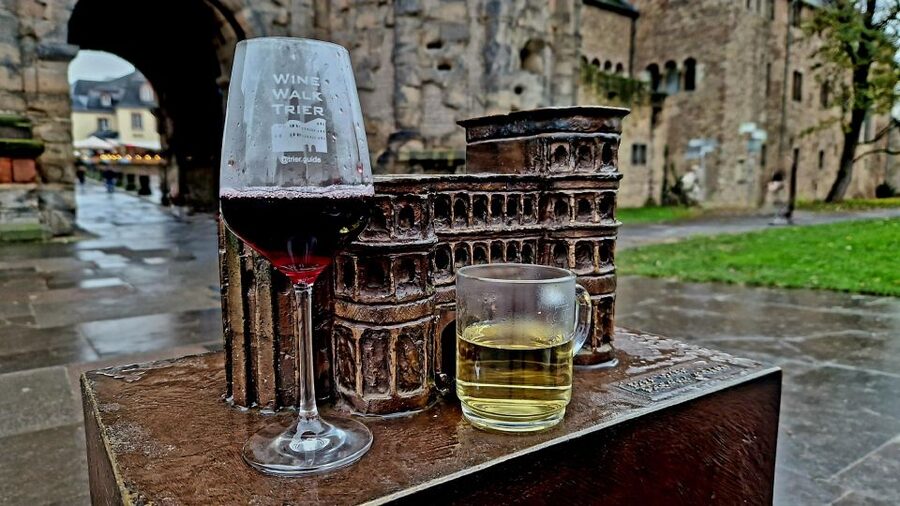
Trier can feel like several cities layered in one place. Roman walls and baths sit beside medieval churches, an imposing cathedral, and the grand Electoral Palace. A self-guided walk can show you the stones, but it may not explain how the pieces fit together.
This tour gives you that connecting thread. You begin near the Porta Nigra, Germany’s oldest city gate, then move through the central sights toward the Forum Baths. Along the way, the guide explains Trier’s Roman beginnings, Christian landmarks, wine-growing traditions, and later history.
The wine adds a useful local angle rather than being a separate activity tacked onto a sightseeing walk. Each bottle has a link to a building, location, or part of Trier’s story. That approach helps you remember the city. You are not only looking at an old wall, you are hearing why that spot matters while tasting something from the Moselle region.
The format also keeps the pace lively. You are rarely parked in one place for too long, and the walk covers a good portion of the historic center in two hours. If you have only one day in Trier, this is an efficient first look.
More Wine Tastings in Germany:
- Reil, Mosel: Guided organic wine tasting and cellar tour
★ 4.8 · 84 reviews - Berlin: Wine on Canvas – Paint Workshop and Wine Tasting
★ 4.7 · 59 reviews - Stuttgart: Stuttgart Wine Museum Wine Tasting
★ 4.7 · 55 reviews
Meeting Simon near the Porta Nigra
The meeting point is on the left side of the Tourist Information office, in front of the city model near the flags. The tour is not operated by the Tourist Information itself, so check the exact meeting instructions before setting off.
This is a sensible starting place. The Porta Nigra is one of Trier’s clearest landmarks, and it gives the walk an immediate sense of scale. The gate was built by the Romans as part of the city’s fortifications, and its dark stonework makes a strong opening scene.
The route is close to the train station, which is useful if you are coming in from Luxembourg or another nearby town. Give yourself enough time to find the flags and city model. One participant arrived a few minutes late and was still welcomed, but arriving on time is the kinder choice for a small guided group.
Simon is often praised for making the opening feel friendly rather than formal. He was born and raised in Trier, and that local connection comes through in the way he answers questions and points out details that can be easy to miss. His style appears to be warm and conversational, with plenty of room for questions.
Porta Nigra and the first taste of Roman Trier
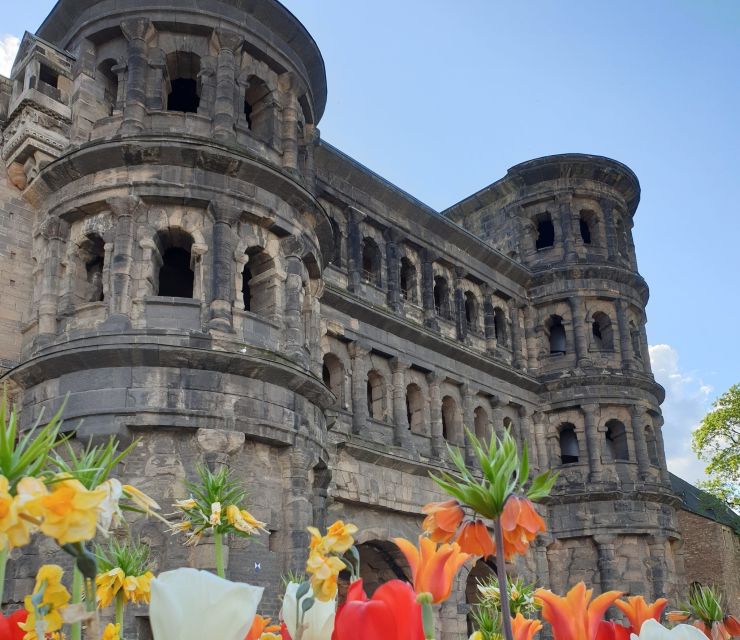
The Porta Nigra is more than a quick photo stop. It is the clearest reminder that Trier was an important Roman city, and it gives you a physical sense of the defensive system that once surrounded it.
You can expect the guide to use the gate as a starting point for the city’s wider story. The tour is not designed as a detailed architectural lecture, but it does give you useful context before you move into the center.
The first wine tasting is connected to the early part of the route. In summer, five regional wines are served during the walk. You also receive water and breadsticks, which matter more than they may sound. The snacks make the tastings more comfortable and help keep the experience from becoming an empty-stomach wine crawl.
The wines are local examples, with Riesling receiving particular praise. The Moselle is strongly associated with this grape, and the tasting gives you a first sense of the region without asking you to spend an afternoon visiting separate wineries.
Market Cross and Trier’s central square
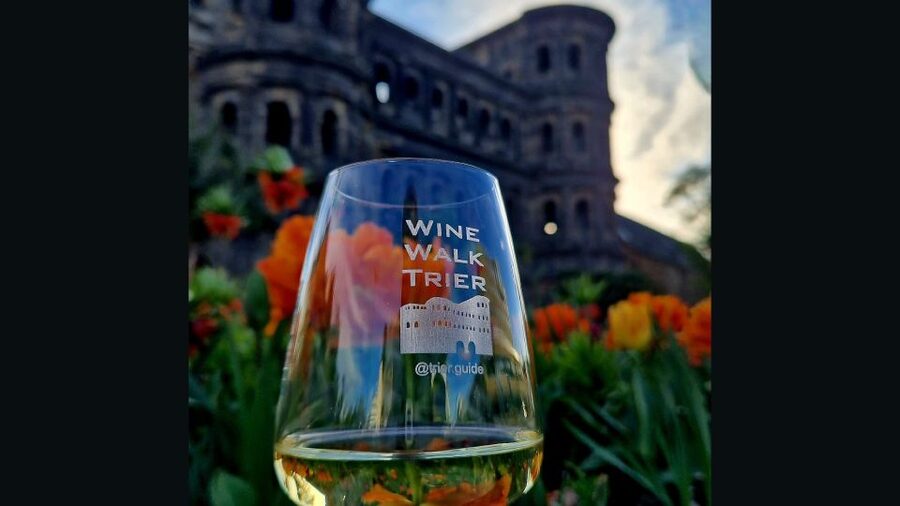
From the Porta Nigra, the walk continues to the Market Cross on the main market. This is one of the most useful stops for getting your bearings in central Trier.
The square brings together daily city life and historic architecture. You can listen to the guide, take photographs, and note where you may want to return later. Several people appreciated having enough time to revisit sites after the tour, and that is good advice. Treat this walk as an introduction, then come back to the places that catch your attention.
The main market is also a good setting for understanding how Trier developed beyond its Roman foundations. The city was not simply preserved as an ancient monument. It continued to function as a religious, commercial, and civic center.
The wine pairing here keeps the stop from feeling like a checklist. You taste, listen, and move on, rather than spending the whole visit standing in a single square. In crowded conditions, though, it may be harder to hear every word. One participant specifically noted that street noise sometimes made Simon difficult to hear, so staying reasonably close to the guide is wise.
More Walking Tours in Germany:
- Stuttgart: Guided Wine Walk & Wine Tasting
★ 4.6 · 28 reviews - Barcelona Tapas and Wine Experience Small-Group Walking Tour
★ 5.0 · 5,804 reviews - Barcelona: Tapas Walking Tour with Food, Wine, and History
★ 4.8 · 4,261 reviews - Lisbon: Food and Wine Small Group Walking Tour
★ 4.9 · 4,082 reviews
Trier Cathedral and Liebfrauenkirche
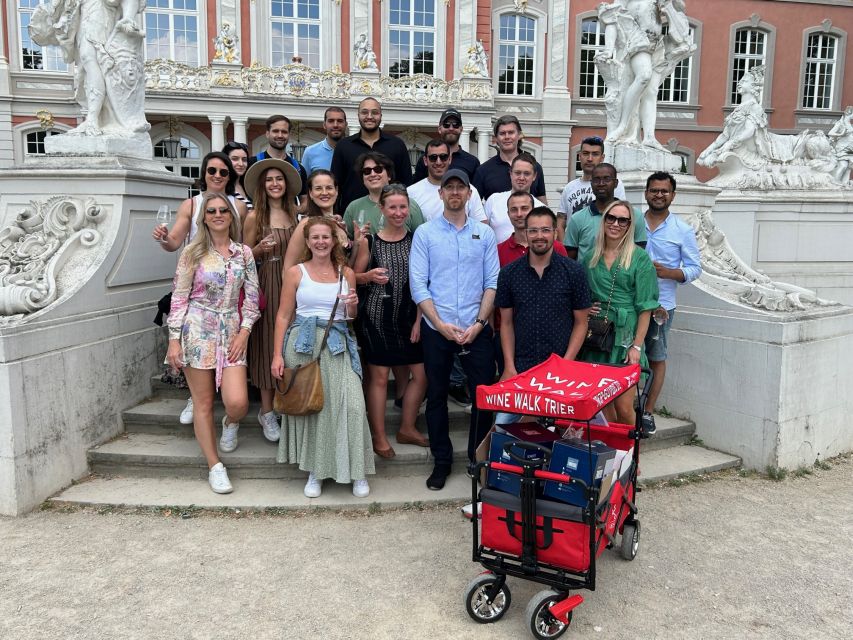
The next section brings you to two of Trier’s major Christian landmarks: Trier Cathedral and the Liebfrauenkirche.
The cathedral adds another layer to the city’s long story. After the Roman period, Trier remained a major religious center, and its churches show how the city changed while retaining older foundations. The guide helps place those buildings within the larger sweep of Roman rule, the rise of Christianity, the Middle Ages, the world wars, and modern Trier.
The Liebfrauenkirche is especially valuable as part of the walk because it provides a contrast to the heavier Roman remains and the massive cathedral. It is also one of the places associated with a tasting, so the wine and architecture are treated as part of the same regional story.
Do not expect a long interior visit at every church. The supplied route describes photo stops, guided explanation, and sightseeing, and the timing is limited to two hours overall. Still, the format can help you identify which interiors deserve a second look after the tour.
This is one reason I would book the walk early in your Trier visit. You can use the route to mark places for a later, slower visit rather than trying to see everything in detail while the group waits.
The Aula Palatina and Electoral Palace
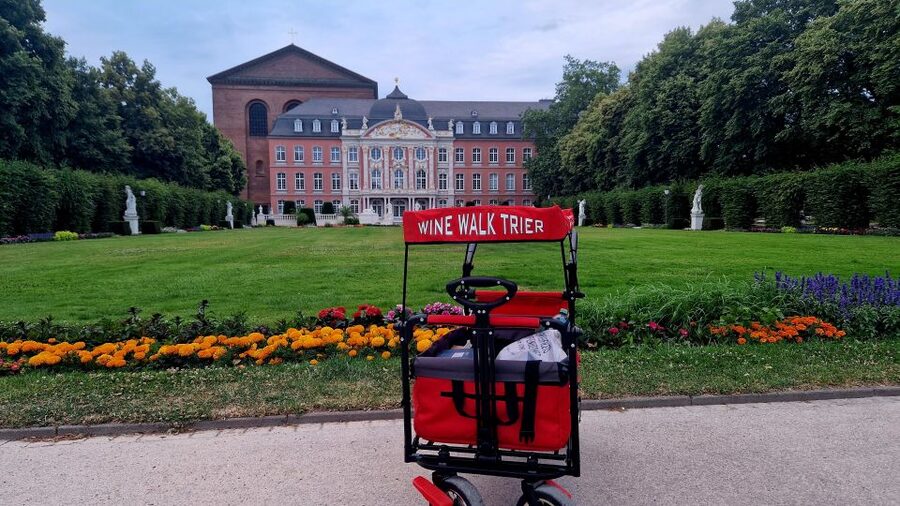
The Aula Palatina, also called the Basilica of Constantine, is one of Trier’s most striking Roman buildings. Its vast interior and plain exterior make it a useful reminder that Roman power was expressed through scale as much as decoration.
The walk then reaches the Electoral Palace, where the Roman and later political histories of Trier meet. The palace grounds add a more refined, courtly note to a route that began with military fortifications and moved through religious buildings.
A tasting is connected with this part of the walk. That pairing helps you see wine as part of regional identity, not simply a drink served for entertainment. The Moselle wine trade has shaped local culture and remains one of the easiest ways to connect Trier with the surrounding countryside.
The guide’s role matters here. A printed guidebook can name the Aula Palatina and Electoral Palace, but it may not explain how to read the change from Roman authority to later ecclesiastical and political power. Simon is praised for making those links clear while keeping the tone light.
Kaiserthermen and the final walk to the Forum Baths
The Kaiserthermen, or Imperial Baths, bring you back to the Roman world. These ruins show the size and ambition of ancient Trier’s public facilities. Even if you are not a Roman-history specialist, the remains give you a better feel for how important the city once was.
The final stop is the Forum Baths at Viehmarkt Square. This is where the tour ends, outside the ruins of a Roman bath complex. The ending is practical because you are left near another significant Roman site rather than being returned to the starting point.
The Forum Baths also make a fitting finish. The walk begins with a Roman gate and closes with Roman bathing ruins, while the middle section brings in churches, markets, palaces, and wine. You get a broad picture of Trier without crossing a huge distance.
The route is described as completely barrier-free and does not require climbing steps. That is useful for wheelchair users and for anyone who wants an easy city walk. The tour still takes place outdoors, so comfortable shoes and clothing suited to the forecast make sense. The experience runs rain or shine.
What the wine tasting is really like
This is a walking tasting, not a seated tasting-room class. In the warmer season, you receive five different regional wines, along with water and breadsticks. The guide explains the connection between each wine and a location or historical theme along the route.
That structure is the strongest part of the tasting. You are not simply sampling five unrelated glasses. The drinks provide pauses in the walk and help tie the Moselle wine-growing region to Trier’s streets.
The selection is praised for its quality, with several people singling out Riesling. The exact bottles can vary, so you should not book this expecting a fixed menu or a formal comparison of vintages. You are getting an accessible introduction to local wines while sightseeing.
Non-alcoholic grape juice is available instead, but it must be arranged by email when booking. That is an important detail for anyone who does not drink alcohol. The supplied information does not promise a separate tasting menu, so ask in advance rather than waiting until the meeting point.
From mid-November through the end of January, the experience may feature four local mulled wines instead of the normal summer-style tasting, provided at least six people register. This sounds particularly suited to Trier’s winter setting, but the seasonal format depends on group numbers. If fewer than six people register, the tour may use five different wines as in summer.
The drinks are served while walking, so anyone looking for a serious wine education course may find the format too informal. For most people, that is also its appeal. The wine gives the history a social rhythm, and the group often becomes more relaxed as the tour continues.
Price, extras, and overall value
At $43 per person, the price is reasonable for a two-hour guided walk with five wines, or four seasonal mulled wines, plus water and breadsticks. You are also paying for a guide who connects the drinks to the city rather than simply handing out samples.
The included voucher adds value. It covers one glass of wine with a main course at Weinwirtschaft Friedrich-Wilhelm next to the Basilica. This gives you a useful dinner option after the walk, although you should read the voucher wording carefully and confirm how it applies to your meal.
A drinking glass can be purchased after the tour for €6, and a wine-glass holder costs €3. These are optional extras, not part of the basic price. If you are trying to keep costs down, you can simply enjoy the included tasting and skip both purchases.
Hotel pickup and drop-off are not included. That is not a serious problem in Trier because the meeting point is central and near the train station, but you should plan your own route to the flags beside the Tourist Information office.
The tour allows cancellation up to 24 hours in advance for a full refund and offers reserve-now, pay-later booking. Those policies are useful if your schedule depends on a day trip or changing weather.
Who should book this experience?
I would recommend this tour to first-time visitors who want a clear introduction to Trier without spending hours inside a museum. It also suits couples, small groups, solo visitors, wine fans, and anyone arriving by train for a day trip.
It is especially good for you if history and food or drink work better together than separately. The tour does not treat wine as a reward after the sightseeing. It uses wine to explain the region and to make the walk more social.
Families can join if the adults are interested in the tasting, and grape juice is available by advance arrangement. The route is also a practical choice for wheelchair users because it is described as barrier-free and step-free.
You may want something else if you prefer a quiet, private tour, a long stop at every monument, or a formal tasting with detailed notes on soil, vintages, and production methods. Street noise can occasionally affect how well you hear, and the rain-or-shine policy means bad weather will not cancel the walk.
Should you book the Trier wine walk?
Yes, if you want to understand Trier quickly and enjoy local wine along the way. The combination of Roman ruins, churches, palace architecture, and Moselle tastings gives you more substance than a standard city stroll, while the two-hour length fits neatly into a busy day.
The best reason to book is the guide. Simon’s local connection, humor, and willingness to answer questions appear to shape the experience as much as the route itself. Book early in your Trier visit, stay close enough to hear him in busy streets, and arrange grape juice in advance if needed.
For $43, this is a strong-value introduction to Trier. It will not replace a full day of monument visits or a dedicated winery excursion, but it can show you where to spend the rest of your time and give you a pleasant taste of the Moselle region.
FAQ
How long is the Trier guided wine walk?
The tour lasts two hours.
Where does the tour meet?
Meet on the left side of the Tourist Information office, in front of the city model near the flags.
Where does the tour finish?
The tour ends at the Forum Baths on Viehmarkt Square.
How many wines are included?
The summer format includes five different regional wines. From mid-November through the end of January, the tour may include four different local mulled wines when at least six people register.
Can I choose grape juice instead of wine?
Yes. Four different grape juices can be arranged, but you must book this option by email.
Is the tour available in English?
Yes. The live guide is available in English and German.
Is the route wheelchair accessible?
Yes. The tour is described as completely barrier-free and does not require climbing steps.
Does the tour run in bad weather?
Yes. The tour takes place rain or shine.
What else is included besides the wine?
The tour includes a guide, walking tour, water, breadsticks, and a voucher for one glass of wine with a main course at Weinwirtschaft Friedrich-Wilhelm beside the Basilica. Hotel pickup and drop-off are not included.
Newly added around Germany
- Sylt: Shell safari with boat | incl. Mussel tasting & 1 glass of wine★ 4.7 · 49 reviews
- Stuttgart: Stuttgart Wine Museum Wine Tasting★ 4.7 · 55 reviews
- Stuttgart: Guided Wine Walk & Wine Tasting★ 4.6 · 28 reviews
- Heidelberg: Hills and Wine Region Segway Tour★ 4.9 · 89 reviews
- Reil, Mosel: Guided organic wine tasting and cellar tour★ 4.8 · 84 reviews
- Mulled wine ride in the Leipzig New Zealand★ 4.3 · 43 reviews
- Lieser: Covered wagon ride, the rolling wine tasting with picnic basket★ 4.7 · 51 reviews
- Kröv, Mosel: Covered wagon ride through the vineyards with wine tasting★ 4.8 · 46 reviews
Wine Tastings, compared.
Douro Valley w/ Boat Tour, Wine Tasting & Lunch
Read our review →
Complete Douro Valley Wine Tour with Lunch, Wine Tastings and River Cruise
Read our review →
Small-Group Wine Tasting Experience in the Tuscan Countryside
Read our review →
Montserrat & Cogwheel Train, Gourmet Wine Tasting & Tapas/Lunch
Read our review →
Tuscany & Montepulciano Day Trip with Lunch & Wine Tasting
Read our review →Browse the lists this tour appears in