
REVIEW · HISTORICAL TOURS
Private Bordeaux History Tour with a glass of Bordeaux wine.
Bordeaux reveals itself on foot. This private two-hour walk links the city’s grandest squares, medieval gates, churches, and UNESCO-listed sights with a guide focused on the stories between the monuments. I like the private format, which keeps the pace flexible, and I like the included glass of Bordeaux wine at a local bar after the walk. The main tradeoff is time: with around a dozen stops in two hours, several places receive only a short introduction.
The route is a useful first look at central Bordeaux, especially if you want to understand how the city shifted from a medieval port to an elegant 18th-century city. Guides Victor and Emma have earned especially warm praise for their clear explanations, personal approach, and ability to follow a group’s interests. You should expect plenty of walking, some quick curbside talks, and no entry inside the monuments.
Key points at a glance
- A private route through Bordeaux’s historic center: Only your group takes part, so you can ask questions and request more detail on architecture, wine, politics, or daily life.
- Fourteen centuries of city-making in two hours: The walk moves from Saint-André Cathedral and medieval streets to neoclassical squares and Belle Époque arcades.
- UNESCO-listed sights without a museum schedule: You see several major monuments from outside, including the cathedral area, Porte Cailhau, and Place de la Bourse.
- A practical introduction to Bordeaux’s English connection: Rue du Loup provides a short lesson on how Bordeaux came under English rule.
- A glass of wine after the walking: The included tasting adds a local finish without turning the experience into a full wine-country excursion.
- A strong choice for first-time visitors: The start near the cathedral and finish at Place des Quinconces make it easy to continue exploring on your own.
What this Bordeaux walking tour really offers
At $90.36 per person, this is not the cheapest way to see Bordeaux’s center. You are paying for a private English-speaking guide, a route through many key sights, and the chance to ask questions without waiting for a large group to catch up.
The value depends on how you travel. If you enjoy finding monuments on a map and reading plaques, you can see many of these places without paying for a tour. If you want the city’s political turns, architectural changes, and wine connections explained as you walk, the price is easier to justify.
The tour is also efficient. Bordeaux’s central sights are spread across a walkable area, and the route gives you a working map of the city in one sitting. You finish at Place des Quinconces, a useful location for continuing toward the river, nearby gardens, or another central neighborhood.
The tour is often reserved about 40 days ahead, so I would not leave it until the last minute if your dates are fixed. Confirmation arrives when you book, and free cancellation is available up to 24 hours before the start time. A late cancellation or late change is not refundable.
More History Tours in Bordeaux:
- Douro Valley: Historical Sites, Wine Experience, Lunch & Cruise
★ 5.0 · 5,133 reviews - Barcelona: Tapas Walking Tour with Food, Wine, and History
★ 4.8 · 4,261 reviews - Sevilla Food Tour: Tapas, Wine, History & Traditions
★ 5.0 · 3,468 reviews
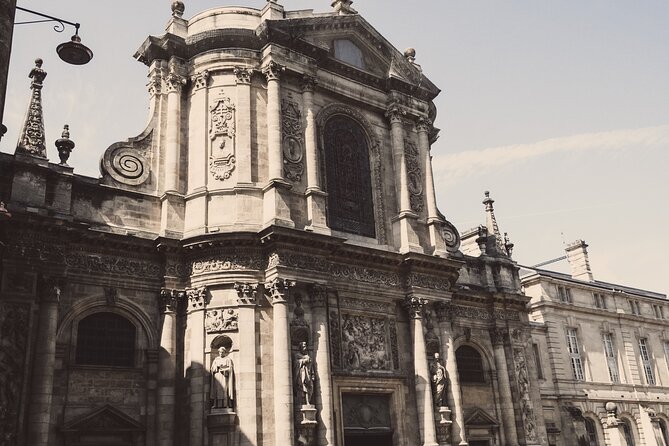
Starting at Saint-André Cathedral
Meet your guide at Cathédrale Saint-André de Bordeaux on Place Pey Berland. This is a sensible meeting point because the cathedral is one of the city’s clearest landmarks and sits near several central streets.
The opening stop focuses on Gothic design, royal power, and Bordeaux’s religious role. The cathedral is linked with the marriage of Eleanor of Aquitaine and King Louis VII, a useful reminder that Bordeaux’s story reaches well beyond local church affairs.
You will have about 15 minutes here. That is enough to examine the façade, carvings, and soaring interior if the doors are open, but not enough for a detailed visit. Since admission inside the monuments is not included, treat this as an orientation stop rather than a cathedral tour.
The nearby Tour Pey-Berland adds another architectural reference point. The route then moves toward the city center, where the guide explains how Bordeaux’s streets changed over time. The walk is less about ticking off isolated buildings and more about connecting them to the way the city grew.
Rue Saint-Catherine, Rue du Loup, and the English connection
The walk includes Rue Saint-Catherine and Promenade Sainte Catherine, an important commercial spine through the center. Rue Saint-Catherine is described as Europe’s longest pedestrian street, and its modern shopping role sits on top of an older route that began as a Roman road.
This is one of the places where a private guide can add useful context. You get a sense of how an ancient line through the city became a shopping street, and how old façades and newer retail spaces now share the same corridor. The stop is not built around a major monument, so the guide’s explanation matters more than the view.
At Rue du Loup, the subject shifts to medieval Bordeaux. You hear how the city became English and see surviving traces of the medieval street pattern and architecture. This is a short stop, about 10 minutes, but it supplies an important piece of the city’s identity.
The English connection is especially useful if Bordeaux is your first stop in southwestern France. It helps explain why wine, trade, and overseas links became so important here. Victor’s explanations have been praised for covering the city’s long period under British rule in a clear way, rather than treating it as a footnote.
Place du Palais and Porte Cailhau
Place du Palais gives you a chance to consider urban design rather than just individual buildings. The guide discusses why the square was created and how its architecture frames the surrounding streets.
From there, the route reaches Porte Cailhau, one of the most memorable sights on the walk. This 15th-century gate once served as a principal entrance to Bordeaux. Its construction celebrated King Charles VIII’s victory at Fornovo, and its Gothic and Renaissance details reflect both civic pride and defensive purpose.
I like this stop because it works on two levels. The gate is photogenic, but it also shows that Bordeaux was once a fortified city with controlled points of entry. Today, it can be easy to stroll past without understanding what it meant. The guide gives it a clear role in the city’s past.
You spend about 15 minutes here. That is enough for an explanation and a close look from outside. It is not enough for a lengthy architectural study or an interior visit, which is not included.
A few more wine tours around Bordeaux worth a look
- Private – Best of Bordeaux Walking Tour + Glass of Bordeaux Wine
★ 5.0 · 240 reviews - Bordeaux Médoc Region Private Wine Lovers Tour with Chateau Visits & Tastings
★ 5.0 · 40 reviews - Saint-Emilion Private Half Day Wine Tour from Bordeaux
★ 5.0 · 38 reviews - Saint-Emilion Private Full Day Wine Tour from Bordeaux
★ 5.0 · 29 reviews
Place de la Bourse and the Grand Théâtre
Place de la Bourse is among Bordeaux’s most recognizable spaces. The tour discusses the square’s design and places it within the larger transformation of Bordeaux into a more ordered and elegant city.
The Miroir d’Eau is also part of the wider Place de la Bourse area. The famous reflecting surface adds a playful modern element to the formal façades. The scheduled time at the square is brief, so you may want to return later if you want photographs or a longer pause.
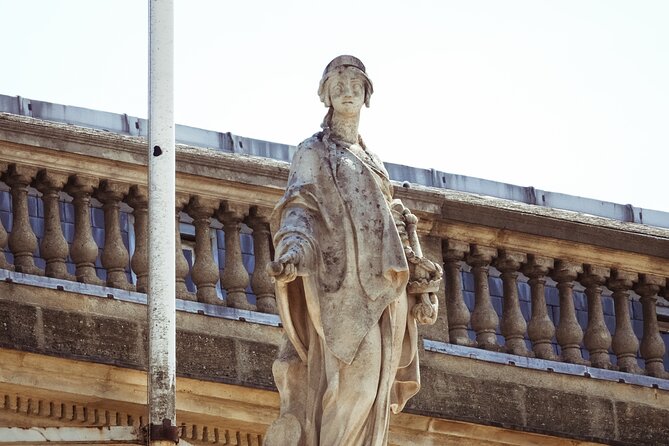
The Grand Théâtre receives another short introduction. Built in 1780 and designed by Victor Louis, it is a major example of neoclassical architecture. Its colonnaded front and statues of the nine muses and goddesses give the building a theatrical presence before you even reach the entrance.
The guide explains the theatre’s continuing role in Bordeaux’s cultural life and points out its grand staircase and chandelier if you choose to visit separately. Since interior admission is not part of the walk, this is best viewed as an exterior lesson and a suggestion for a later visit.
Gambetta, Passage Sarget, and Place du Chapelet
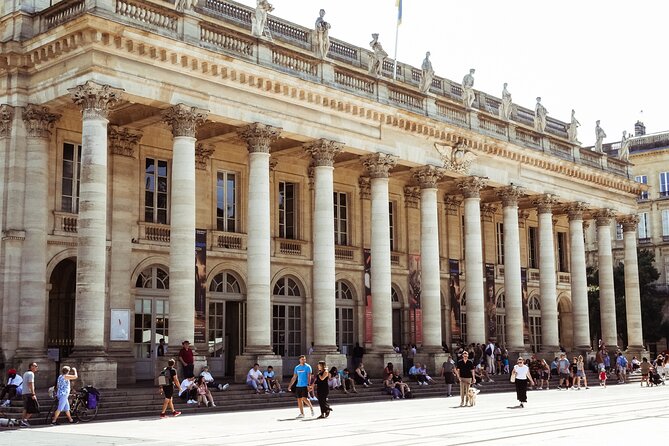
Place Gambetta offers a pause from the dense streets. Its history includes the former western gate, 18th-century urban changes, and political events connected with the French Revolution. Today, its gardens provide a calmer setting for a short explanation.
This stop is useful because it shows that Bordeaux is not only grand façades and riverfront monuments. Squares such as Gambetta reveal how the city’s public spaces were reshaped for daily use, movement, and civic life.
Passage Sarget changes the mood again. Built in the late 19th century, this covered passage links Rue de la Porte-Dijeaux with Place des Grands-Hommes. Glass roofing, ironwork, stone details, shops, and cafés give it a distinctly Parisian arcade feel.
The passage recalls Bordeaux’s Belle Époque ambitions and its taste for covered shopping streets. You may find this stop more interesting if you enjoy urban details, shopfronts, and smaller architectural features. It is not a headline attraction, but it breaks up the larger monuments nicely.
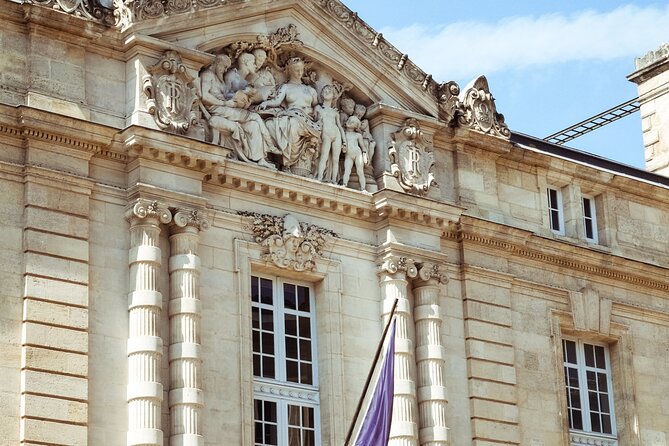
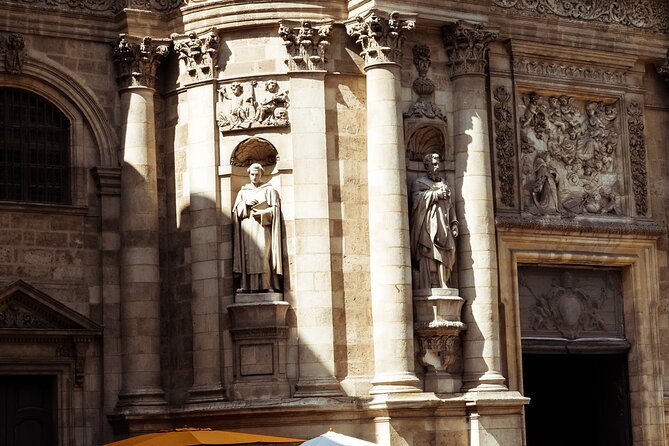
At Place du Chapelet, the focus turns to the Church of Notre-Dame. The 17th-century church is known for its organ, which still sounds during special performances. The site also has a connection with the funeral of a famous 19th-century painter. Again, the tour presents the church from the outside unless you arrange a separate interior visit.
Allées de Tourny and the Monument aux Girondins
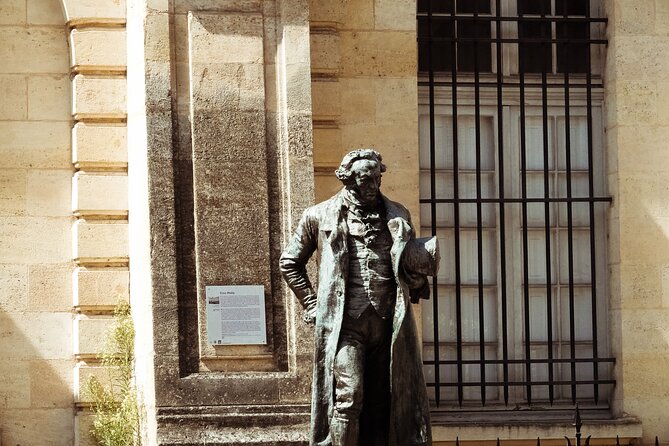
Allées de Tourny is a broad, tree-lined avenue shaped by one of the figures behind Bordeaux’s major urban improvements. The guide connects the avenue’s classical design with wider ideas about city planning, including influence on later development in Paris.
This section helps explain why central Bordeaux feels so spacious and composed in places. The city was not left as a random medieval maze. Major projects widened routes, framed squares, and created grand views.
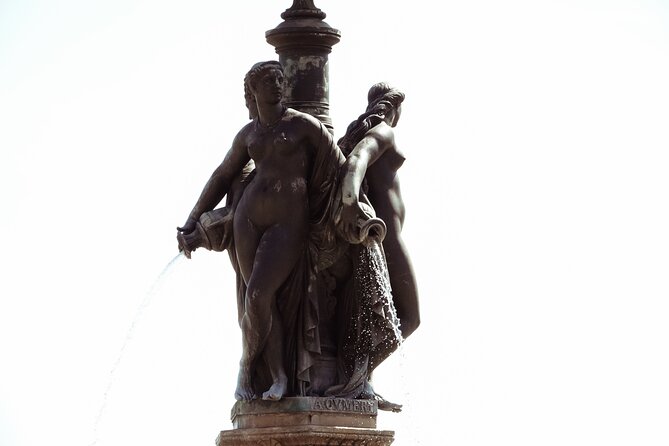
The final major stop is the Monument aux Girondins at Place des Quinconces. The monument honors Girondin deputies who died during the French Revolution and uses dramatic sculpture to represent liberty, the Republic, and Bordeaux’s maritime identity.
Place des Quinconces is one of the city’s largest public spaces, so the monument has room to make an impression. The scheduled stop is short, about five minutes, but the symbolism gives you plenty to notice. I would pay attention to the figures and the overall vertical design, then return later if revolutionary history or public monuments interest you.
The tour ends here, which is practical. You are not left back at the starting point, but the finish is central and well placed for the next part of your day.
The pace, guide style, and private format
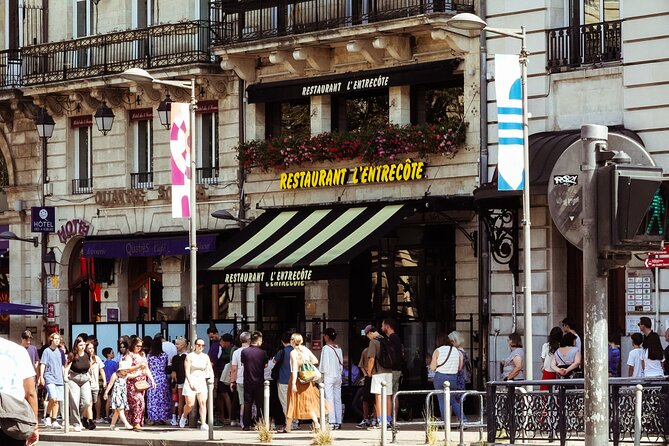
The route lasts about two hours and includes roughly a dozen stops. The timing tells you what kind of experience this is: a brisk survey, not a slow architectural seminar.
A private group makes the format more useful. You can ask why Bordeaux’s wine trade became so powerful, request more detail about the English period, or spend an extra moment on a building that catches your eye. The exact flexibility will depend on the guide and the clock, but a private booking is still more personal than a fixed large-group walk.
Victor is praised for adapting explanations to specific interests, while Emma is described as thorough, friendly, and informative. The strongest pattern is the guides’ ability to make the city understandable, not simply recite dates.
Arrive on time. One group had a delayed start because of traffic and parking, and the guide was accommodating, but a late beginning puts pressure on a route already packed with stops. Comfortable walking shoes are a sensible choice, and you should plan for a mix of pedestrian streets, squares, and regular city pavement.
The tour is offered in English. Most people can take part, and service animals are allowed. Public transportation is nearby. The experience is private, but it does not include monument entry, so budget extra time and money if you want to go inside the cathedral, theatre, or other sites.
The included Bordeaux wine
The final glass of Bordeaux wine is a small feature, but it changes the tone of the experience. After two hours of streets, dates, and architecture, you have a chance to sit at a partner bar and taste a local product connected to the city’s identity.
This is not a vineyard visit or a full wine education session. It is one glass, included with the tour. I see it as a pleasant closing touch rather than the main reason to book.
The wine stop also makes sense as a bridge to the rest of your trip. If you want a deeper look at Bordeaux’s wine regions, you would need a separate excursion. Here, the tasting simply gives the city’s trade story a direct and enjoyable finish.
Who should book this Bordeaux tour?
I would choose this walk if you are visiting Bordeaux for the first time, have limited time, or prefer a guide to explain what you are seeing. It is particularly useful for history-minded visitors who want links between medieval Bordeaux, English rule, the French Revolution, urban planning, and the wine trade.
It also suits couples, families, or friends who value a private pace and want to ask their own questions. The English-language service makes it easy to follow complex historical changes.
I would be more cautious if your main goal is wine tasting, museum interiors, or a slow photography walk. The tour gives you a broad look at the city, but most stops are short and outside. You may also prefer a self-guided route if you dislike fixed timing.
At $90.36 per person, the best value comes from the guide’s interpretation and the private setting, not from admission fees. For a compact introduction to central Bordeaux, that is a fair trade if you want context rather than just directions.
Should you book it?
Book this tour if you want Bordeaux explained in a compact, personal walk. The strongest features are the private format, the number of major landmarks covered, the useful discussion of Bordeaux’s English past, and the included glass of wine.
Skip it if you want extended time inside monuments or a dedicated vineyard experience. Otherwise, it is a practical first-day activity that helps you get your bearings fast, learn which places deserve a second visit, and finish with a taste of Bordeaux in your glass.
FAQ
How long does the private Bordeaux history tour last?
The tour lasts approximately two hours.
What language is the tour offered in?
The tour is offered in English.
Is this a private tour?
Yes. Only your group participates in the activity.
Where does the tour begin?
It begins at Cathédrale Saint-André de Bordeaux on Place Pey Berland.
Where does the tour end?
The tour ends at Place des Quinconces.
Is wine included?
Yes. One glass of Bordeaux wine at a partner bar is included.
Are monument entrance fees included?
No. The tour does not include entrance inside the monuments.
Is the guide’s gratuity included?
No. Gratuities for the guide are not included.
Can I cancel for a full refund?
Yes, if you cancel at least 24 hours before the experience start time. Cancellations made less than 24 hours before the start time are not refunded.
Are service animals allowed?
Yes. Service animals are allowed, and the experience is near public transportation.
Newly added around Bordeaux
- Saint Emilion Full Day Wine and Bike Tour★ 5.0 · 167 reviews
- Luxurious full day Bordeaux wine tour in a Tesla★ 4.5 · 31 reviews
- Private – Best of Bordeaux Walking Tour + Glass of Bordeaux Wine★ 5.0 · 240 reviews
- Wine Masterclass & Cheese Tasting Workshop in Bordeaux★ 5.0 · 29 reviews
- Bordeaux wines tasting workshop including Food & Wine pairings★ 5.0 · 31 reviews
- Bordeaux Wine Masterclass: Blending workshop with appetizer★ 5.0 · 113 reviews
- Medoc Afternoon Wine Tour – 2 Wineries, tastings & delicacies★ 4.5 · 74 reviews
- Discovery of the Bordeaux vineyard in 3 wines★ 5.0 · 133 reviews
Historical Tours, compared.

Douro Valley: Historical Sites, Wine Experience, Lunch & Cruise
Read our review →
Tapas Walking Tour with Food, Wine, and History
Read our review →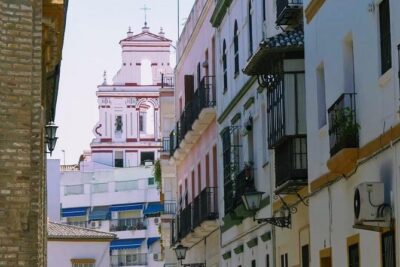
Sevilla Food Tour: Tapas, Wine, History & Traditions
Read our review →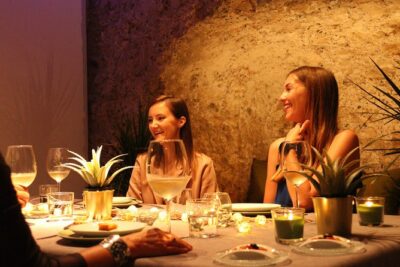
Valencia Old Town Tour with Wine & Tapas in 11th Century Historic Monument
Read our review →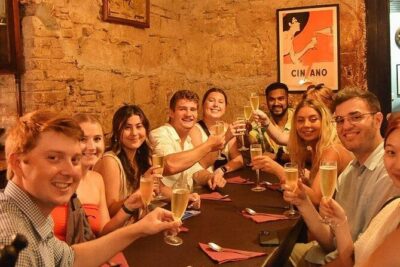
Barcelona Tapas Walking Tour: Food, Wine & History
Read our review →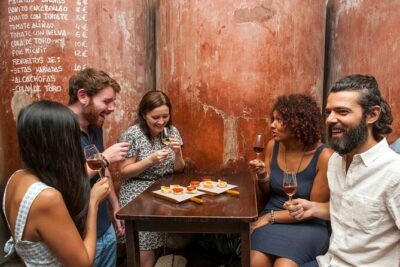
Ultimate Seville Tapas, Wine & History Small Group Tour
Read our review →
Daytime or Sunset Boat Cruise with History and Wine
Read our review →
Undiscovered Charleston: Half Day Food, Wine & History Tour with Cooking Class
Read our review →Browse the lists this tour appears in